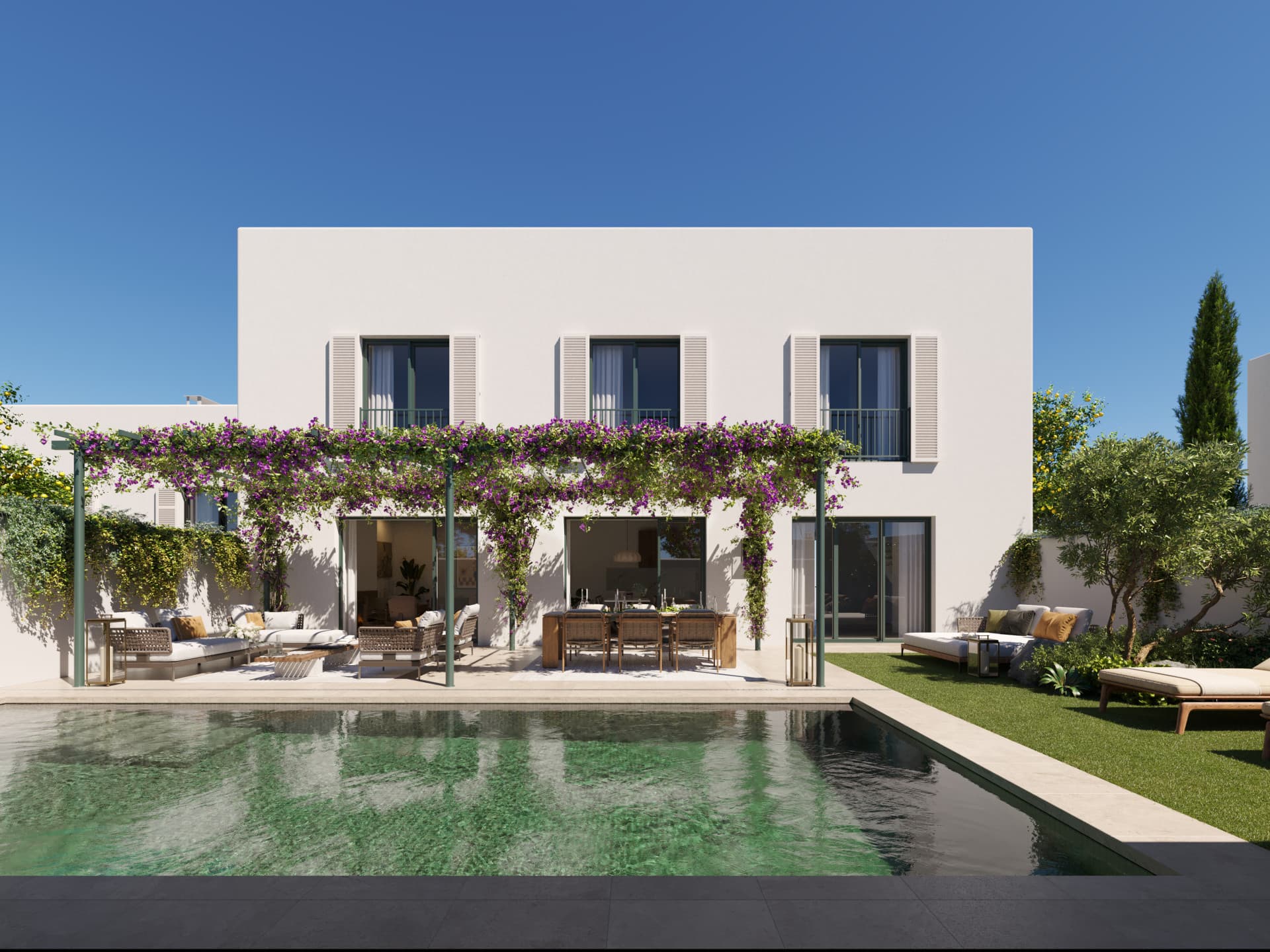
Sotogrande's garden homes — a villa feel, half the upkeep, gated and green.
A semi-detached villa here is the middle path between an apartment and a full standalone house: you get your own front door, a private garden and usually a private pool, but you share one wall and a fraction of the maintenance that a large detached plot demands. Most run to three or four bedrooms, typically somewhere between 200 and 280 square metres of build, set on modest plots within a managed, gated community. They suit people who want the space and privacy of a villa without spending every weekend on the garden.
You'll find the best of them clustered in a few places. Los Cortijos de la Reserva, inside La Reserva Club, is the smart modern address — Andalusian-influenced townhouses and semis behind 24-hour security, a short drive from the golf. Las Villas de Los Álamos in Sotogrande Costa offers a run of garden homes in a calmer, more traditional setting near the beach, while Sotomar and Las Terrazas up in Sotogrande Alto give you leafy, established streets close to Valderrama. As a guide, this type generally runs from the high six figures into the EUR 1.5m–1.8m band for the newer, larger builds — and we'll always tell you which ones are priced ahead of what they'll fetch again.
Sotogrande's planned quiet — cork-oak avenues, Valderrama on the doorstep, polo each August.
Sotogrande sits at the far western end of the Costa del Sol, just inside the province of Cádiz in the municipality of San Roque — about twenty-five minutes from Gibraltar and an hour and a quarter from Málaga airport along the AP-7. It began in 1964, when Joseph McMicking quietly bought a run of farmland either side of the Guadiaro river and laid out one of Europe's largest privately planned estates: low-rise, generously plotted, golf at its heart. That founding discipline has never loosened. There are no towers here, no strip of neon, and the cork oaks predate the houses. People who find Marbella loud tend to find Sotogrande exactly right.
Who lives in Sotogrande
Madrid, mostly, in summer — whole families decamp south in July and August, when the polo season at Santa María and Ayala fills the marina terraces. The year-round community is quieter and more international: British, Dutch, Scandinavian and Spanish households anchored by the international school, plus a contingent of serious golfers who came for Valderrama and the Real Club and stayed for everything else. Gibraltar professionals commute the twenty-five minutes home. What unites them is a taste for privacy over display; wealth here tends to wear deck shoes rather than logos, and the social calendar runs on sport — golf, polo, sailing, padel — rather than nightlife.
The neighbourhoods, briefly
Sotogrande Costa is the original estate below the A-7, and its oldest corner — the Kings and Queens, where the avenues carry the names of Spanish monarchs — remains the most sought-after address, all flat walks under mature trees to the beach and the Real Club de Golf. The Paseo del Parque is the grandest of those avenues. Above the motorway, Sotogrande Alto wraps around Valderrama and the Almenara courses with larger plots, gentler prices and broader views. The Marina is the modern quarter, threaded with waterways — apartments and town houses over the water, berths below — while La Reserva, on the highest ground, is where most new building is concentrated, from the Village Verde parkland apartments to the vast architect-designed plots of The Seven. Torreguadiaro, the fishing village next door, supplies the tapas bars.
Architecture & property types
Villas dominate, and always have. The classic Sotogrande Costa house is a single or two-storey villa from the estate's first decades, set on a plot of one to three thousand square metres or more — Andalusian roof tiles, deep porches, gardens that have had half a century to mature. In the Alto and La Reserva the same generous plots increasingly carry contemporary builds: flat roofs, glass walls, pools aimed at the Rock of Gibraltar or the sea. Town houses are the steady second strand — around the marina, in gated Alto communities and in newer parkland schemes — and suit buyers who want lock-up-and-leave without garden staff. Semi-detached villas form a smaller third run, mostly in the Alto, and are often the best value per square metre of floor area. Apartments cluster at the marina, notably along Ribera del Marlín. Nothing rises above a handful of storeys; the planning rules have held since the founding.
Price expectations
You'd typically expect a detached villa to start around €1.5 million, with the broad middle of the market — good plots in the Alto or the Costa's quieter avenues — generally running between €2.5 million and €5 million. The Kings and Queens and the prime rows of La Reserva are a different conversation: from around €4 million to well past €10 million, with The Seven's plots beyond even that. Town houses generally run €600,000 to €1.2 million, semi-detached villas tend to sit between roughly €700,000 and €1.5 million, and marina apartments from about €350,000 to €850,000. The premium drivers are the same as ever: south orientation, mature trees, walking distance to the beach or the Real Club, and not being able to hear the A-7 from the terrace.
Lifestyle, schools & getting around
Golf is the spine of the place: Real Club de Golf Sotogrande, the Robert Trent Jones course that opened with the estate in 1964; Valderrama, of 1997 Ryder Cup fame; La Reserva; Almenara; and the municipal La Cañada, where green fees are mercifully ordinary. Polo at Santa María and Ayala peaks in late July and August. Sotogrande International School teaches the International Baccalaureate from age three to eighteen and takes boarders — which alone settles many family relocations — while Spanish state schools sit in neighbouring Guadiaro and Pueblo Nuevo. Beaches run from Playa de Sotogrande past Torreguadiaro to the coves at Cala Sardina, with La Reserva's inland sand-edged lagoon for the children. Gibraltar airport is about twenty-five minutes away, Málaga around an hour and a quarter, Marbella forty minutes east when you want noise, and the San Roque–La Línea railway station a short drive inland.
How we work in Sotogrande
We've spent twenty years on this coast, and Sotogrande rewards that kind of patience: much of the best stock changes hands quietly, between neighbours and through agents trusted on the estate, before a portal ever sees it. We walk every house we offer at different hours, because the A-7 sounds different at seven in the morning and the levante finds some gardens and spares others. We'll always tell you which homes are over-priced and why — there are villas here trading on an address that the survey won't flatter — and we'll say so plainly when the semi-detached one street over is the wiser buy. If Sotogrande's particular quiet sounds like yours, drop us a line.